Electronic Communications Technology
Electronic Communication Technology
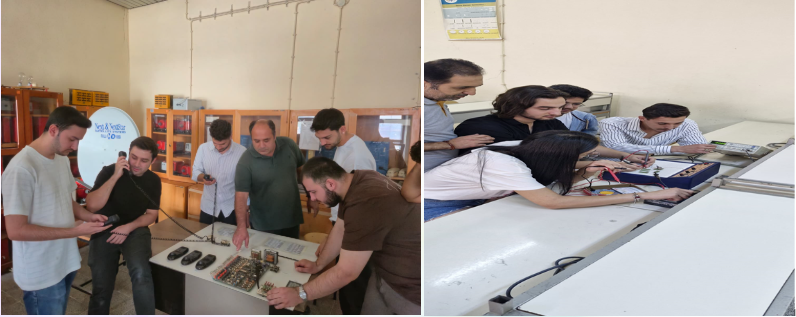
The Electronic Communication Technology Program is a two-year associate's degree program established to meet the need for intermediate manpower in the telecommunications field. During this period, topics related to communication technology are taught through practical application using laboratory facilities provided by the World Bank.
Institution Information
Our program was established in 1987. In 1992, it was included in the scope of the YÖK-World Bank Second Industrial Training Project. As part of this project, three fully equipped laboratories, each with a capacity of 30 people, were established, and the faculty members in the program received training abroad in their fields. Evening education was offered in the program starting in the 1997-1998 academic year and continued for approximately 20 years. In 2018, evening education was closed in accordance with a decision by the Council of Higher Education (YÖK). Currently, the department continues its formal education with three academic staff and students.
Qualification Earned
Electronic Communication Technician
Degree Level
Associate Degree
Admission and Registration Requirements
A high school diploma and the ability to take the Higher Education Institutions Exam (YKS) administered by ÖSYM and be placed in the program.
Regulations Regarding Recognition of Prior Learning
An exemption exam is administered at the beginning of the semester for foreign language courses included in the department's compulsory curriculum.
Students who successfully complete the exam are exempt from the relevant course.
Furthermore, new students enrolling in the program may request exemption from courses they have previously taken and passed at another higher education institution, as per Article 14 of the Mersin University Associate and Undergraduate Education and Examination Regulations.
Qualification Requirements and Regulations
To earn an associate's degree in Electronic Communication Technology, students must:
Successfully complete all courses in the curriculum (120 ECTS credits in total),
Achieve a minimum GPA of 2.00 out of 4.00,
Complete a 20-day mandatory internship.
Program Profile
The Electronic Communication Technology program provides theoretical and practical training in communication systems, electronic circuits, data transmission, and modern communication technologies.
Students gain knowledge and skills in analog and digital communication systems, modulation techniques, antennas, fiber optic systems, data networks, and microcontroller-based systems.
The program aims to train qualified technicians who can install, maintain, and manage communication systems used in industry.
Graduate Employment Profiles
Graduates of the Electronic Communication Technology program: They are employed in public and private sector organizations, telecommunications companies, broadcasting systems, fiber optic infrastructures, and automation units.
Graduates can also work as communication systems technicians, network technicians, telecommunications maintenance personnel, or electronics technicians.
Transfer to Further Studies
Students who graduate from the program can transfer to undergraduate programs such as Electronics Engineering, Communication Engineering, Electrical and Electronics Engineering, or Computer Engineering if they achieve a sufficient score on the Vertical Transfer Exam (DGS).
Exams, Assessment, and Evaluation
Students are subject to midterm exams, midterm work (homework, projects, quizzes, presentations, etc.), and a final exam for each course.
The final grade is calculated by contributing 40% of the midterm exam and 60% of the final exam.
All exams are graded out of 100, and a minimum score of 50 on the final exam is required. Students who receive a grade of AA, BA, BB, CB, or CC in a course are considered successful.
They are entitled to take a make-up exam for failed courses.
Graduation Requirements
Successful completion of all courses (120 ECTS), a minimum GPA of 2.00/4.00, and completion of a 20-day mandatory internship are required.
Students who meet these requirements are awarded the Electronic Communication Technician Diploma.
Departmental Facilities
The program includes three fully equipped laboratories established as part of the YÖK-World Bank Second Industrial Training Project.
These laboratories allow students to acquire both theoretical and practical skills in communication systems, measurement techniques, and electronic applications.
The program also includes a modern computer laboratory, communication systems measurement equipment, and experiment sets.
Graduates can transfer to the following undergraduate programs:
Computer and Control Education
Electrical Education
Electronics Engineering
Electronics Engineering
Electronics Education
Electronics and Computer Education
Electronics and Communication Engineering
Electronics and Communication Education
Industrial Technology Education
Energy Education
Physics
Aviation Electrics and Electronics
Control Education